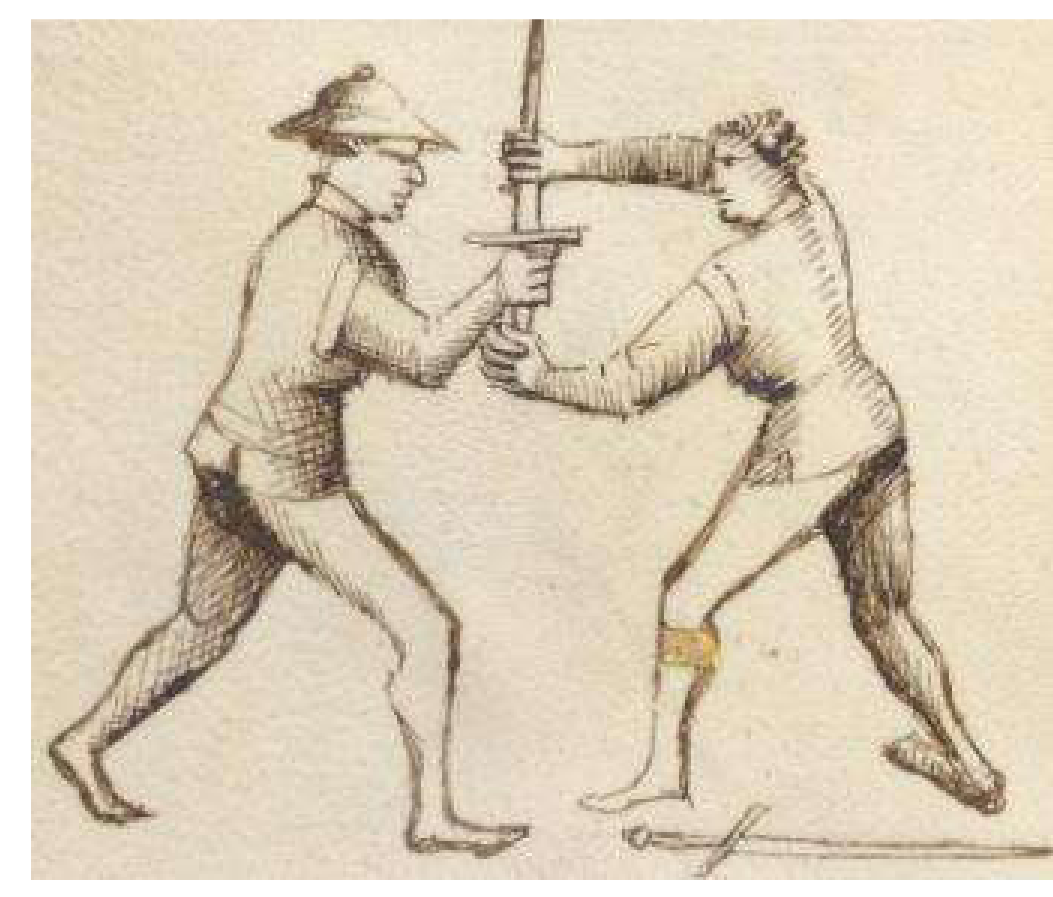
Narrow plays are narrow in directions available. You generally have to go through your opponent to get to safety. Moving offline mostly requires giving an opening or going through the sword which means you have to push your opponent.
You get into narrow play when lead foot is on the same side as your opponent's (eg, your right, their left)
Here begins the play of the sword in two hands, the narrow play, the method of breaking all thrusts and cuts, in the which will be every method of covering, striking, and binding, and dislocations, and grapples, and taking the sword, and beating to the ground in diverse ways. And there will be remedies and counters of every type that should offend or defend. We stand here crossed and from this crossing that we make, all the plays that follow us can be made, and by one of us as easily as the other. And all of these plays will follow, one after the other, as was previously said.
[28r-b] ¶ Using the crossing my Master made with his right foot forward, I now complete the first play as follows: I pass forward with my left foot, and I reach over my right arm with my left hand, seizing his sword-grip in the middle, between his hands. And from here I can strike him with either my edge or my point. This grip can be made when fighting with the twohanded sword or the one-handed sword. And I can make this grip by reaching either under or over the crossed swords.
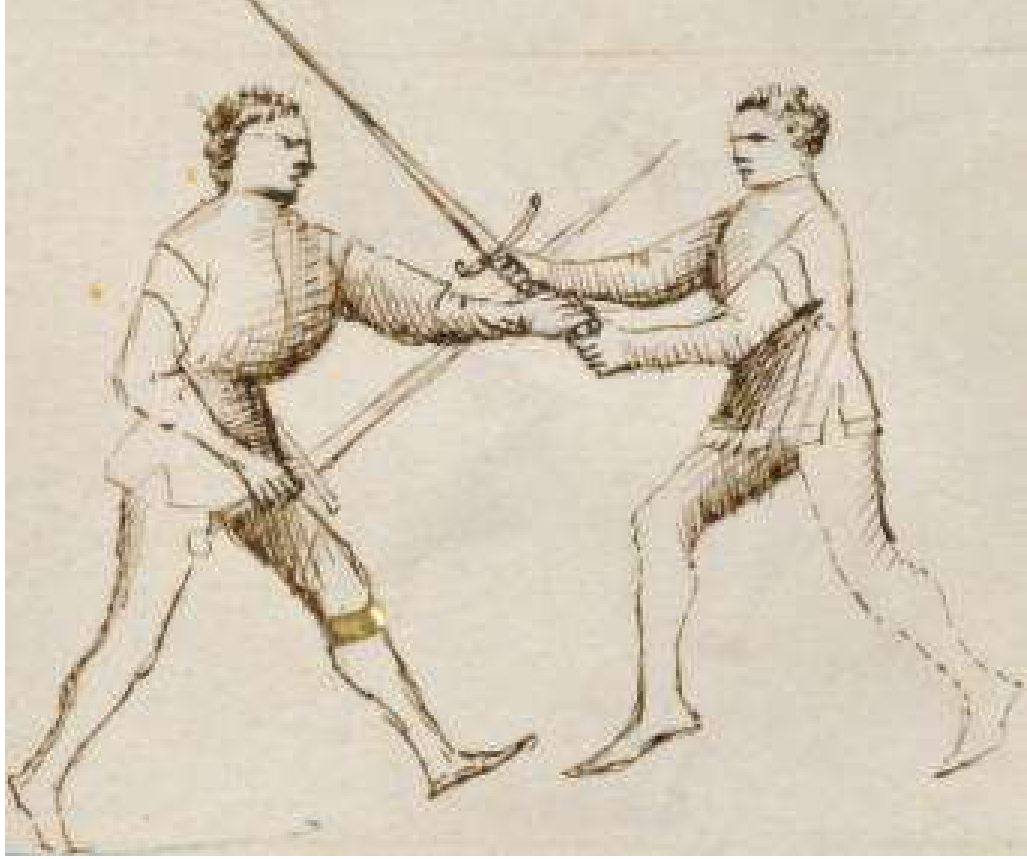
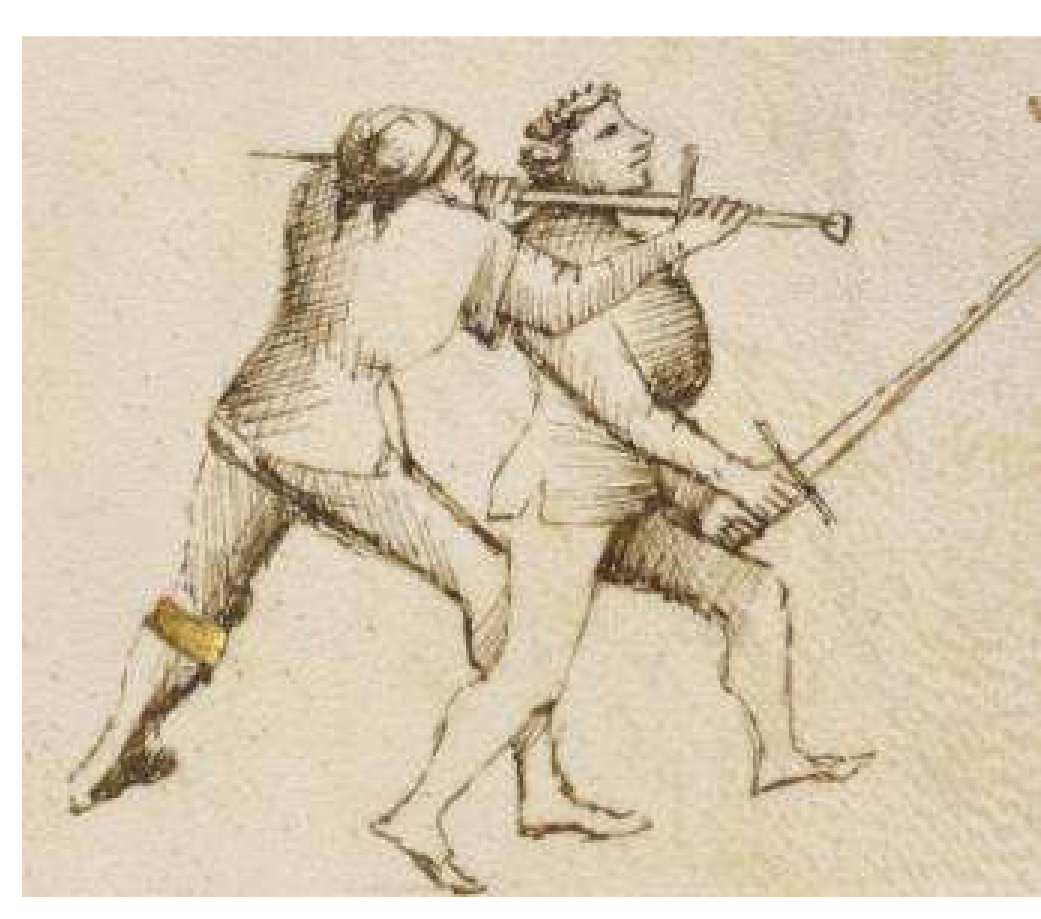
[28r-c] ¶ This is another play that flows from the crossing of my Master. And from that crossing I can make this play and all of the others that follow. In this play I grip my opponent at the elbow as shown, and then strike him in the face with the pommel of my sword. After that I can also strike him in the head with a downward strike before he has a chance to make cover against me.
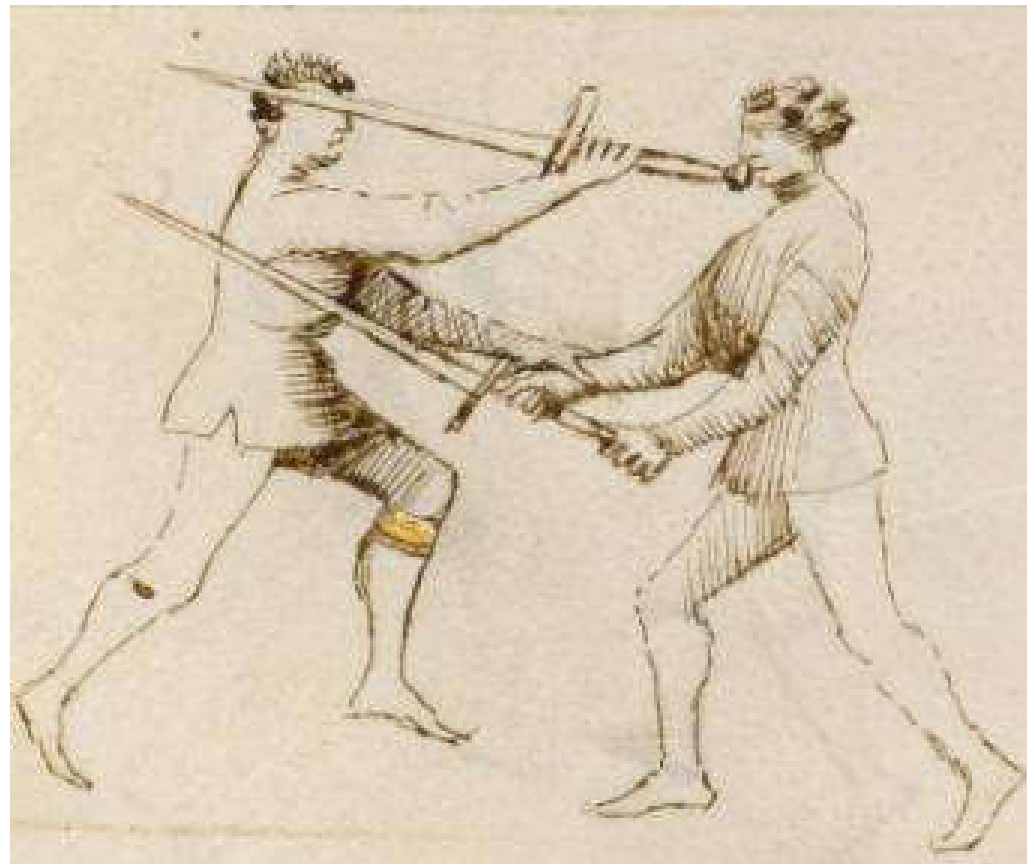
[24a-a] From the cover of the forehand, thus have I caught you: My sword will be in your face, and you will be laid out on the ground.
The good old pommel strike, fast, effective, low scoring. Satisfying. TBH nothing quite sets up the difference between HEMA and sport fencing like using the wrong end of your sword. Get used to doing that with control and gentleness. It will hit harder than you expect and you will really appreciate the value of a good fencing mask.
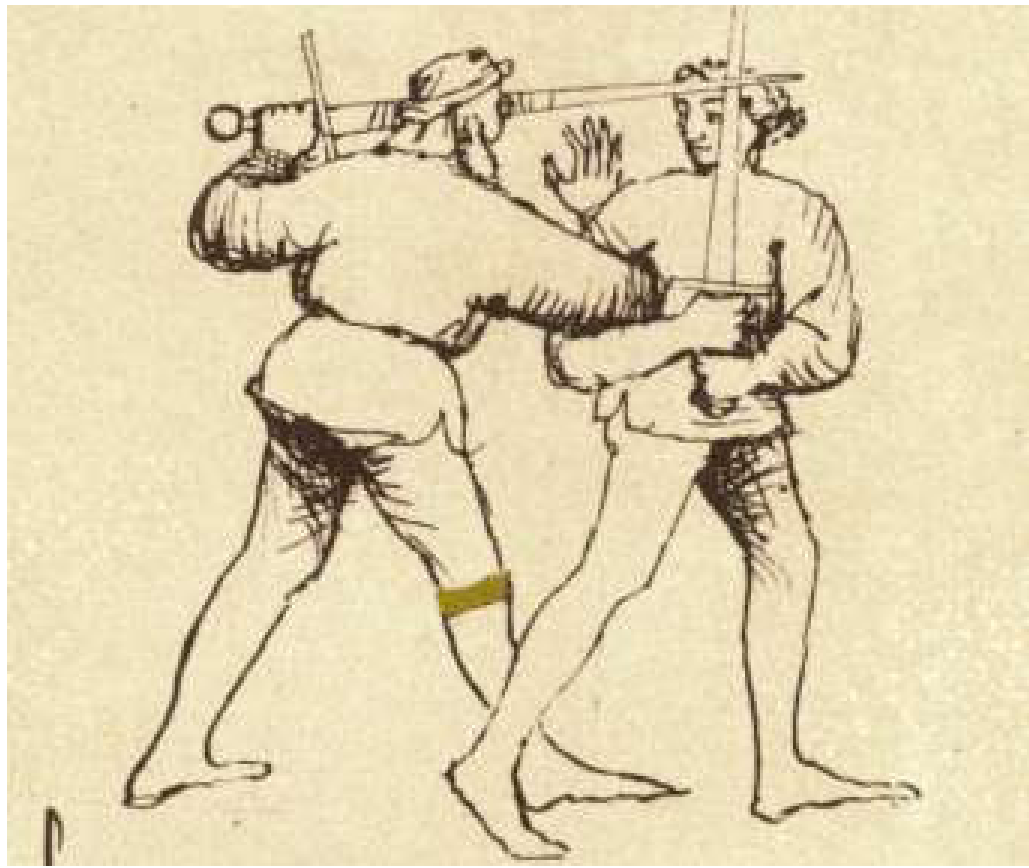
This is another pommel strike, which is effective against a man with or without armor. Make this strike against a man with or without armor. Make this strike quickly if his face is unprotected, and you will certainly hurt him. I if his face is unprotected, and you will certainly hurt him. I can tell you from experience that with this strike you’ll can tell you from experience that with this strike you’ll have him spitting out four teeth. From here, if you wish, you can also throw your sword around his neck, as my fellow also throw your sword around his neck, as my fellow student will show you will show you next
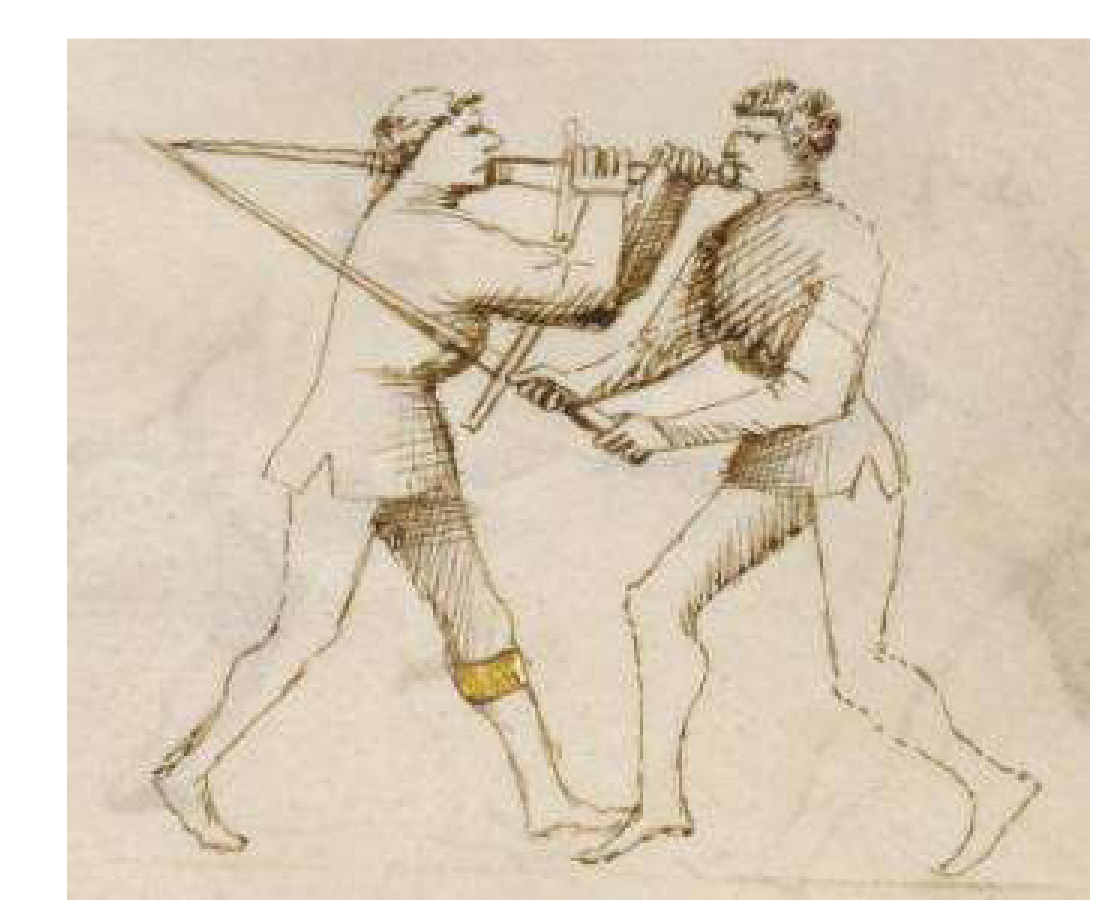
As the student who preceded me told you, after doing the previous play I now put the sword-edge into doing the previous play I now put the sword-edge into your neck. And from here, if I discover that you have no neck neck. And from here, if I discover that you have no neck armor, I will easily cut your throat.
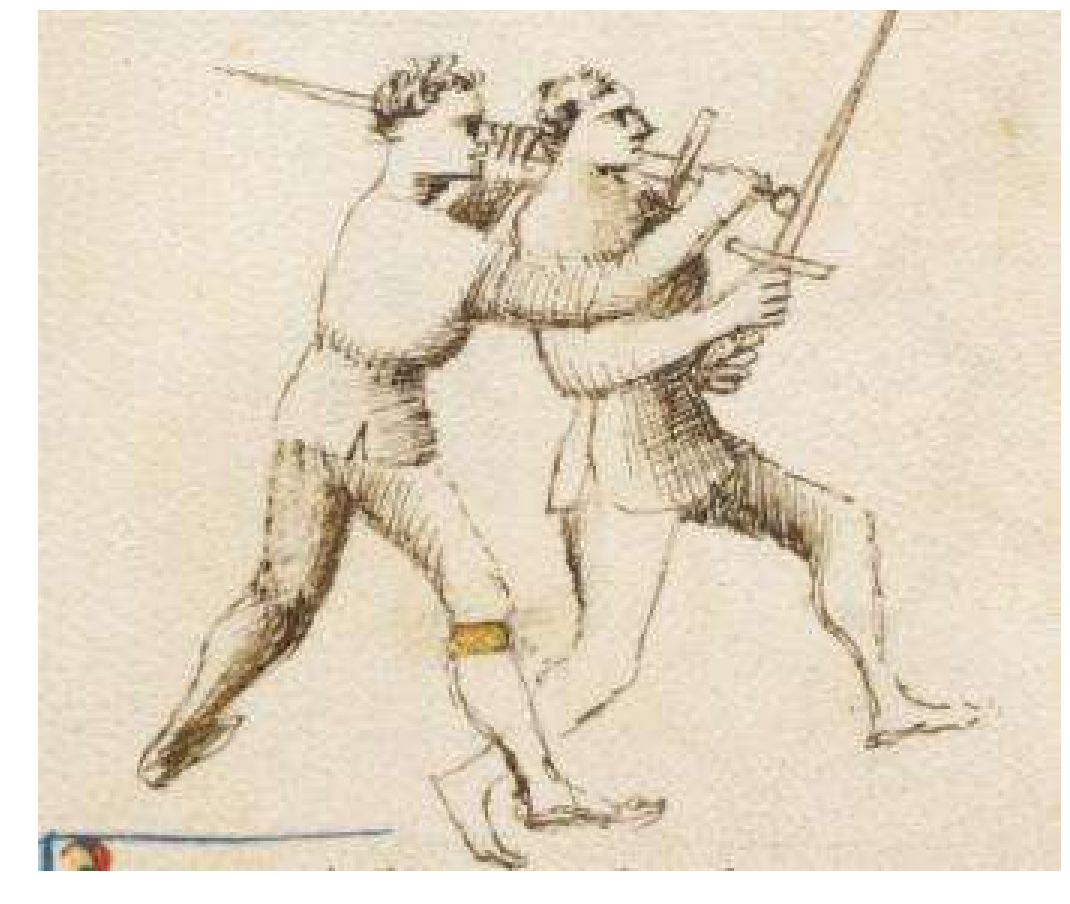
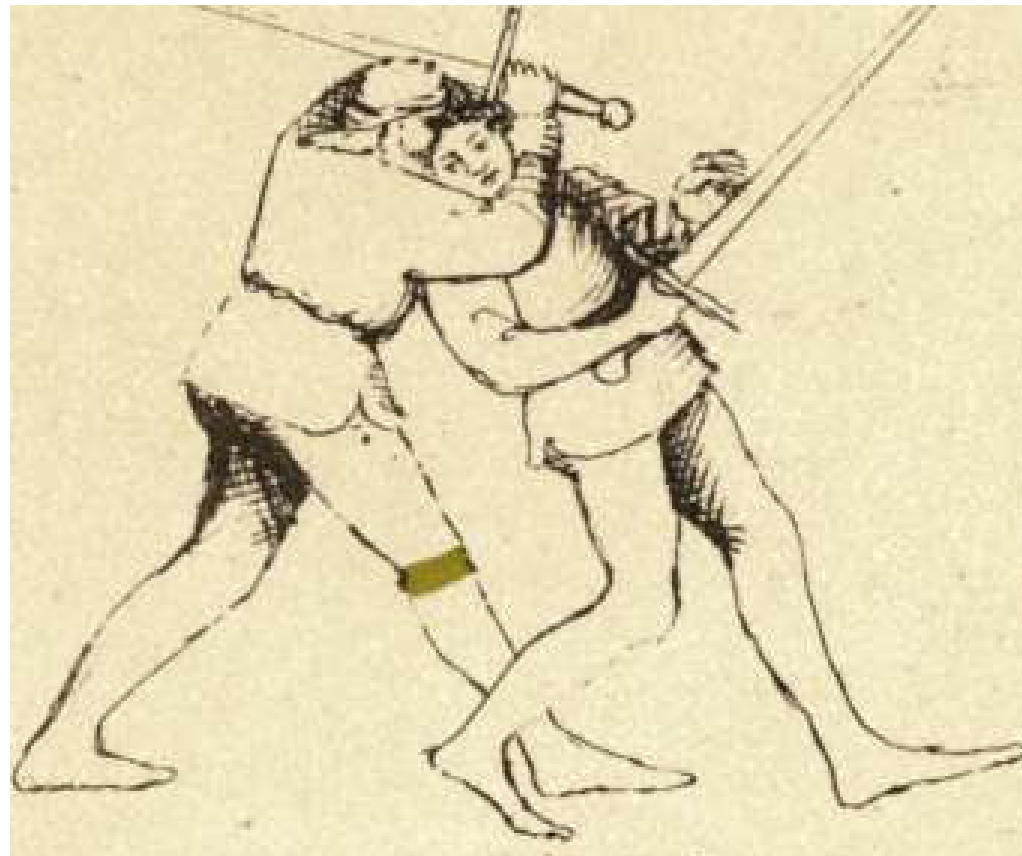
This play is made in this fashion: that is, that one goes with a middle blow against a middle blow to his left side, and then quickly goes to the narrow with a cover. He throws his sword to the neck of his companion, at the same time grasping his right hand with his left (as you see depicted here). He can then throw him to the ground without fail, thrusting his right foot behind [the player’s] right
This play is performed as follows: against a crosswise strike from his left, you meet it with a crosswise strike of your own from your left. Then you quickly move to close range under cover, and then throw your sword around your opponent’s neck, as you see drawn here. From here you can easily throw him to the ground
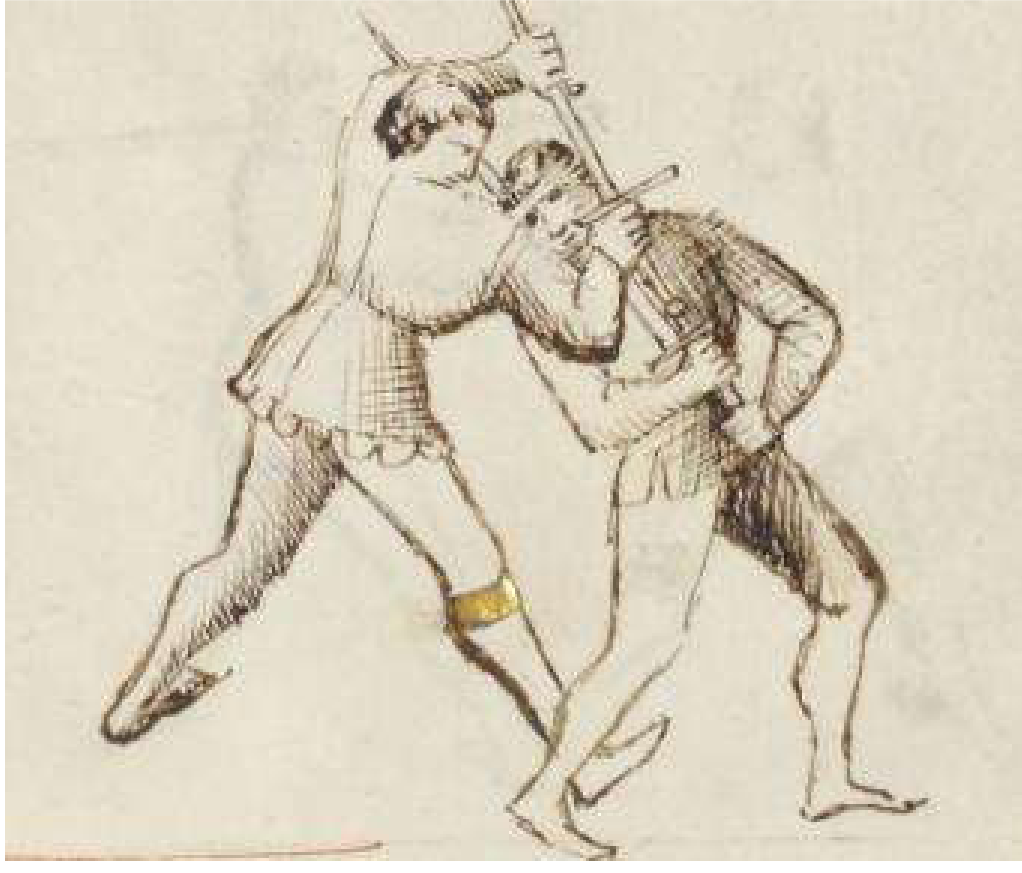
First Counter to the Fourth Remedy
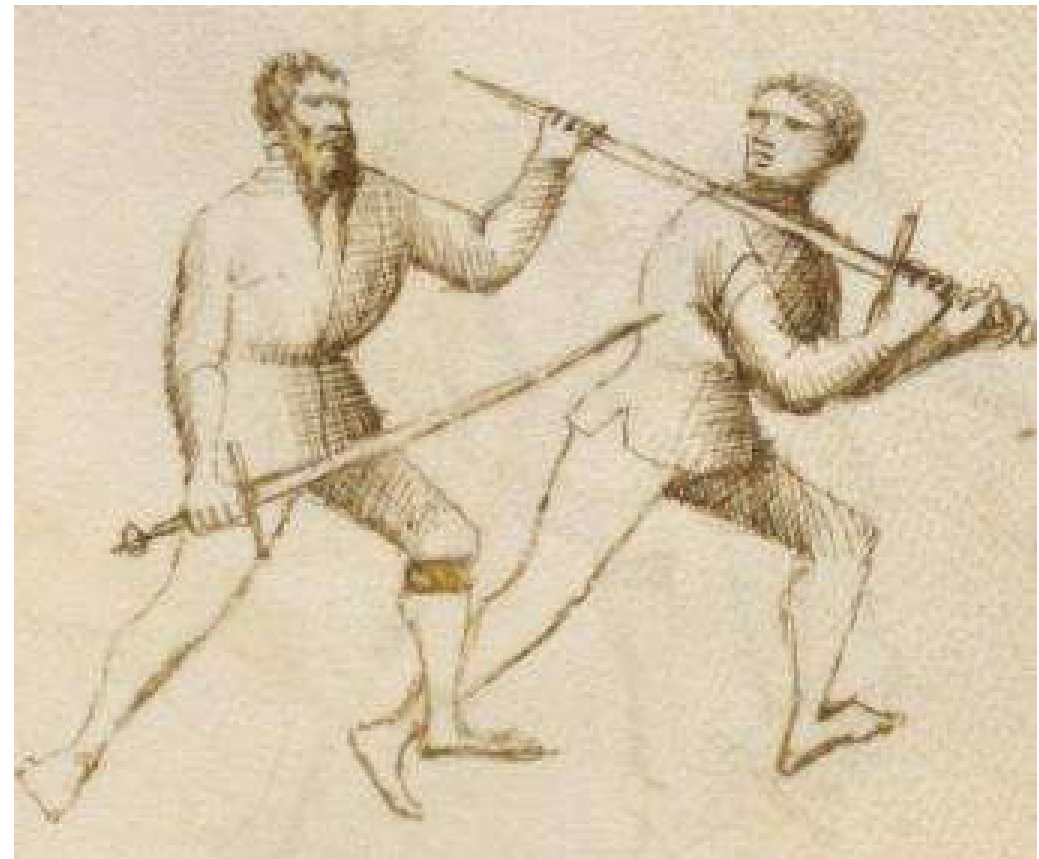
If he covers from his right side, seize his sword with your left hand as shown and strike him with a thrust or a cut. Then after striking him hard, if you wish, you can drop your own sword and cut his face or neck with his own sword, in the manner shown by the student in the next picture.
First Scholar of the First Counter
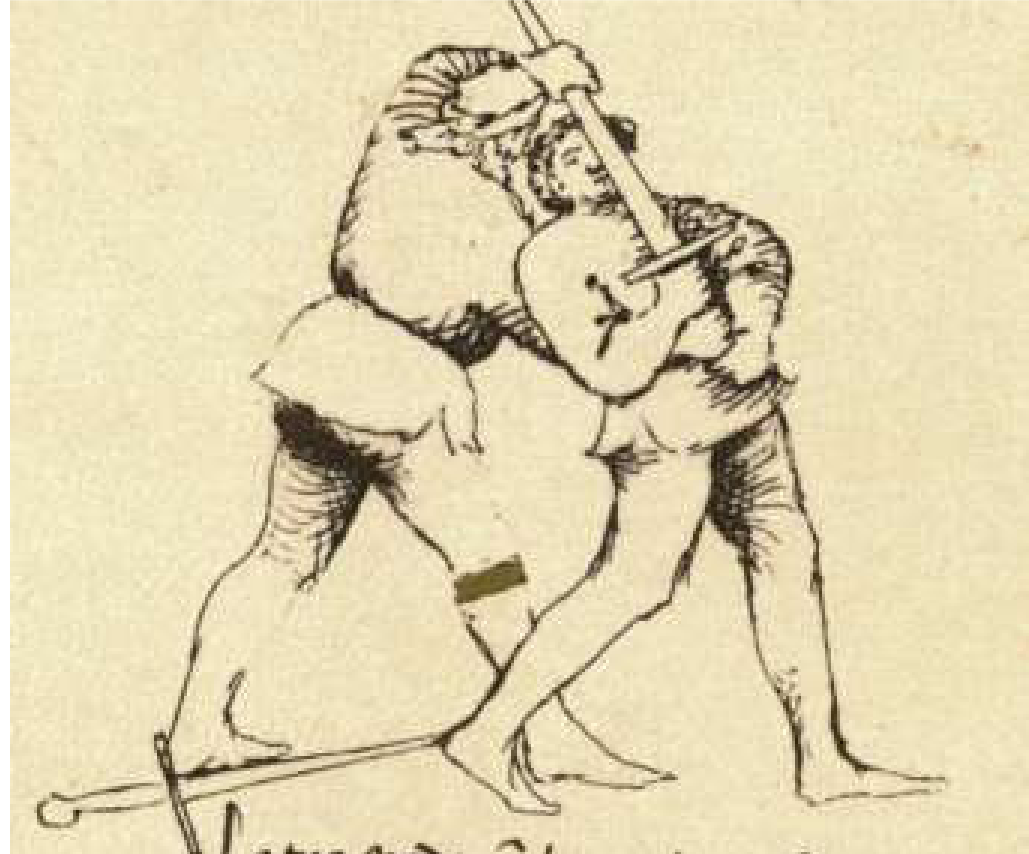
Following on from the play of the student before me, I cut my opponent’s face with his own sword, and then force him to the ground. Here I am demonstrating just how effective this art really is.
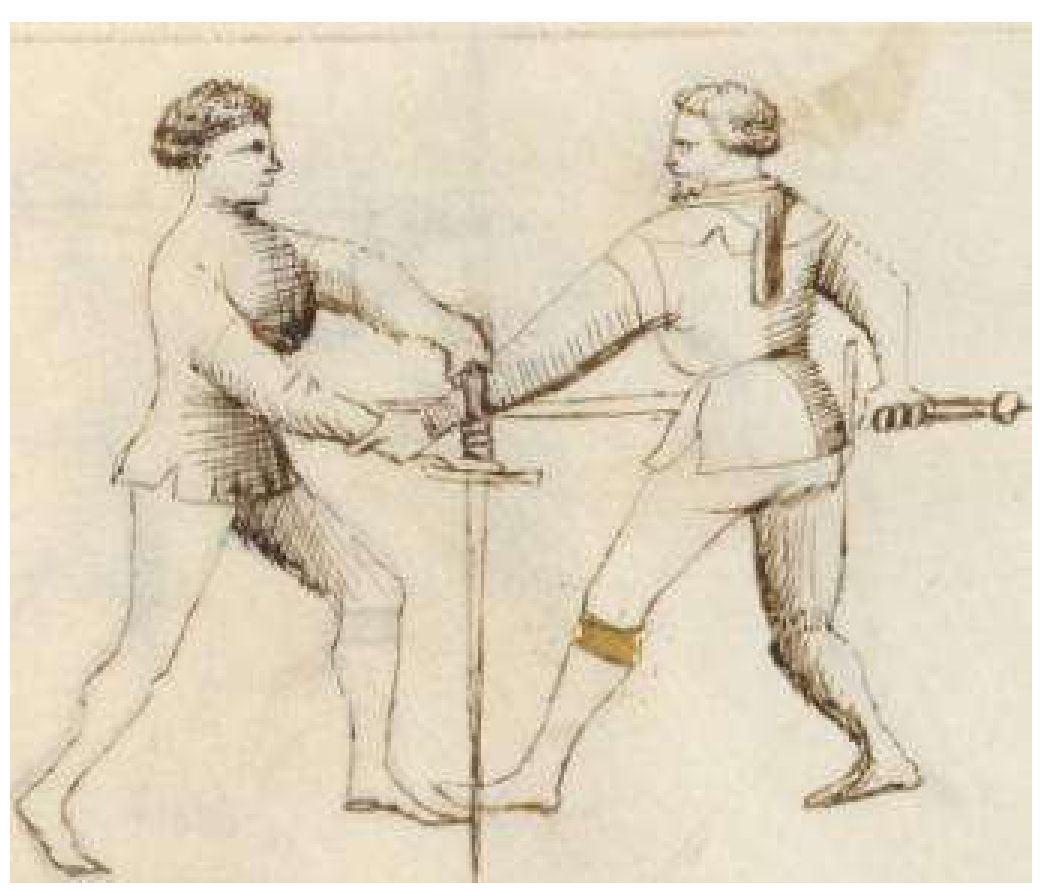
[23b-a] This is the cover of the backhand For making plays of the greatest deceptiveness.
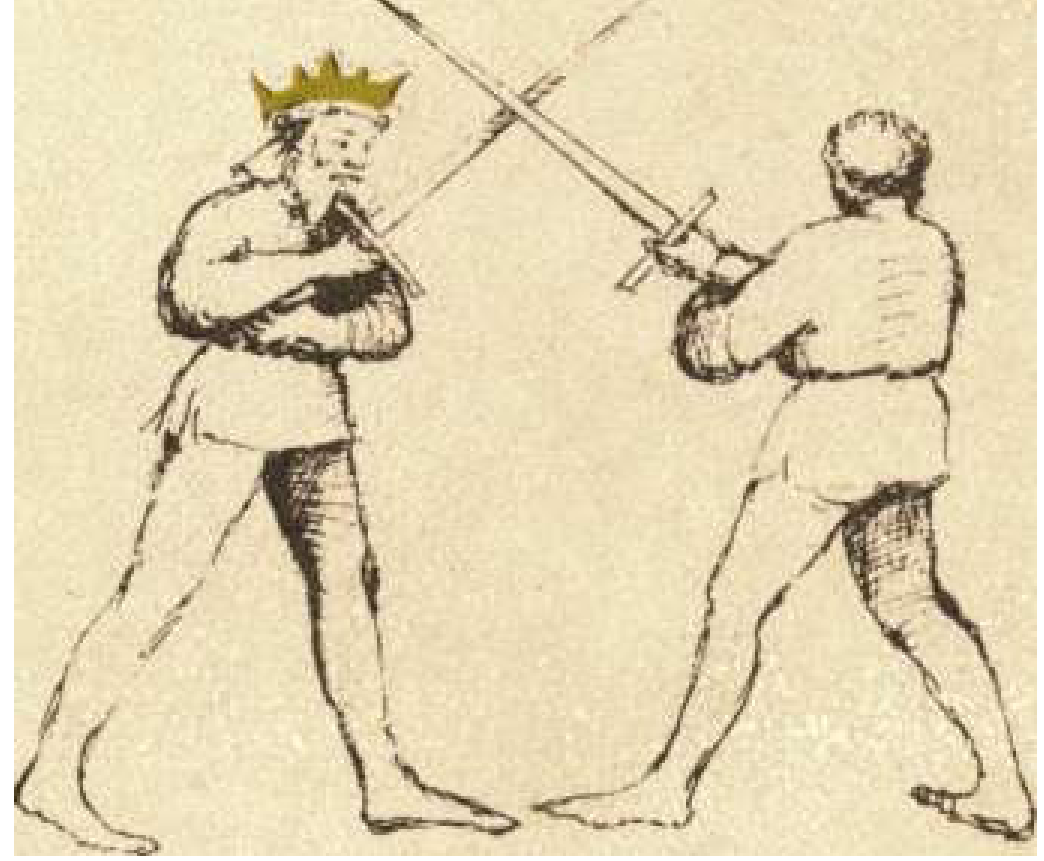
[29r-c] ¶ If he covers from his left side, grab his left hand including his pommel with your left hand, and pull it upwards and backwards. From there you will be able to strike him with thrusts and cuts.
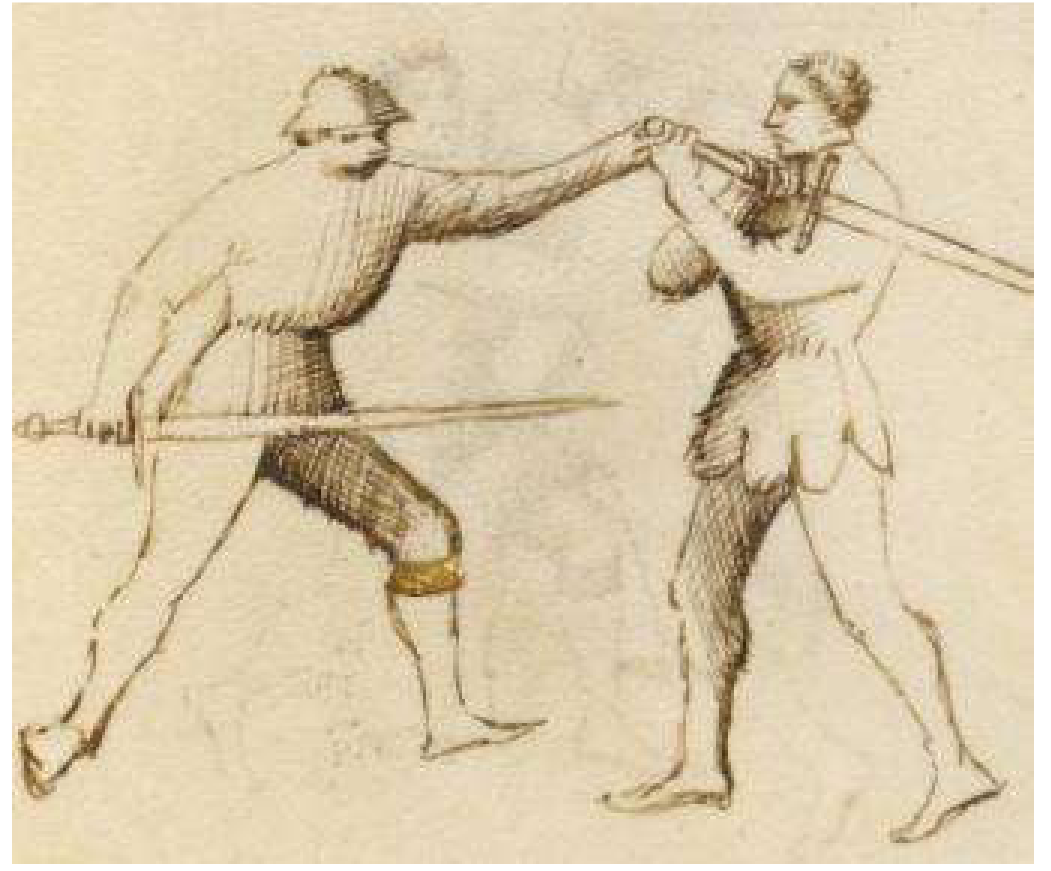
[28r-b] ¶ In order for you to be able to overthrow my sword, with the left hand You have come. But here also, you yourself will die by means of the counter.
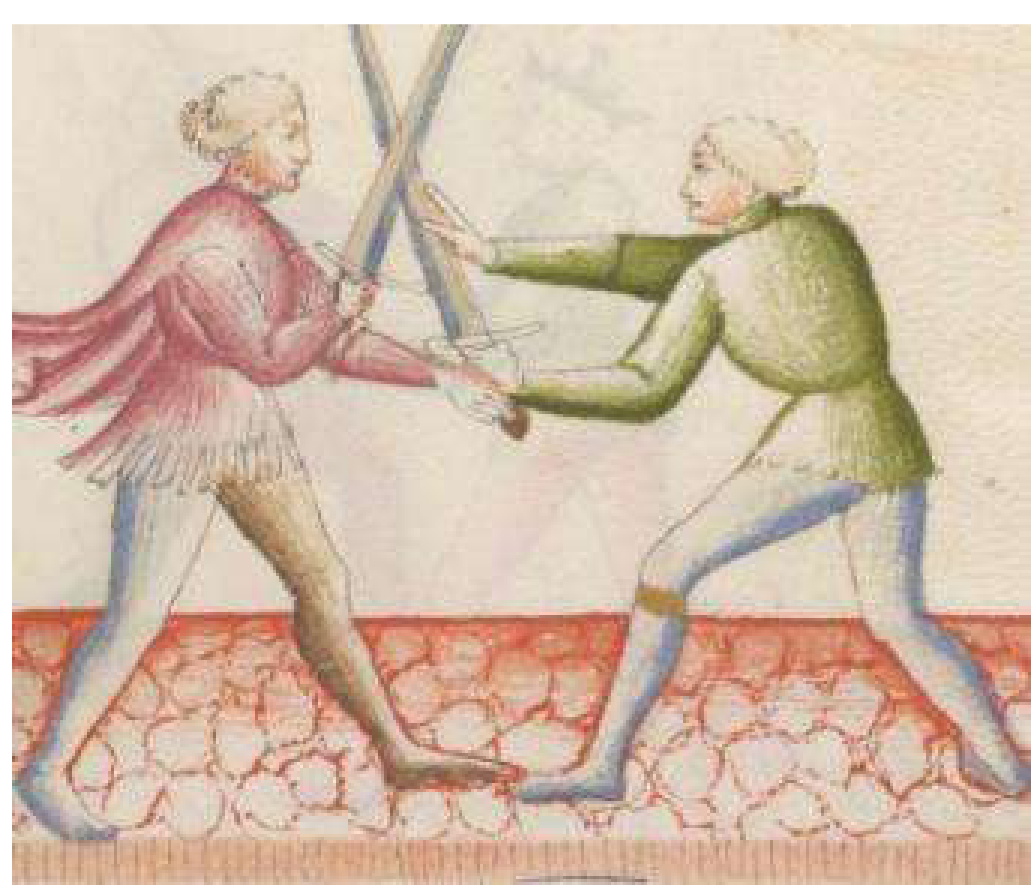
[28v-d] ¶ When I am crossed I move to the Narrow Game, and I place the hilt of my sword between your two hands. Then I push your two hands upwards so that your sword is high. From here I throw my left arm over your arms from the left, binding them with your sword pinned under my left arm. Then I will strike multiple times until I am exhausted. The student who follows me will show you what happens next.
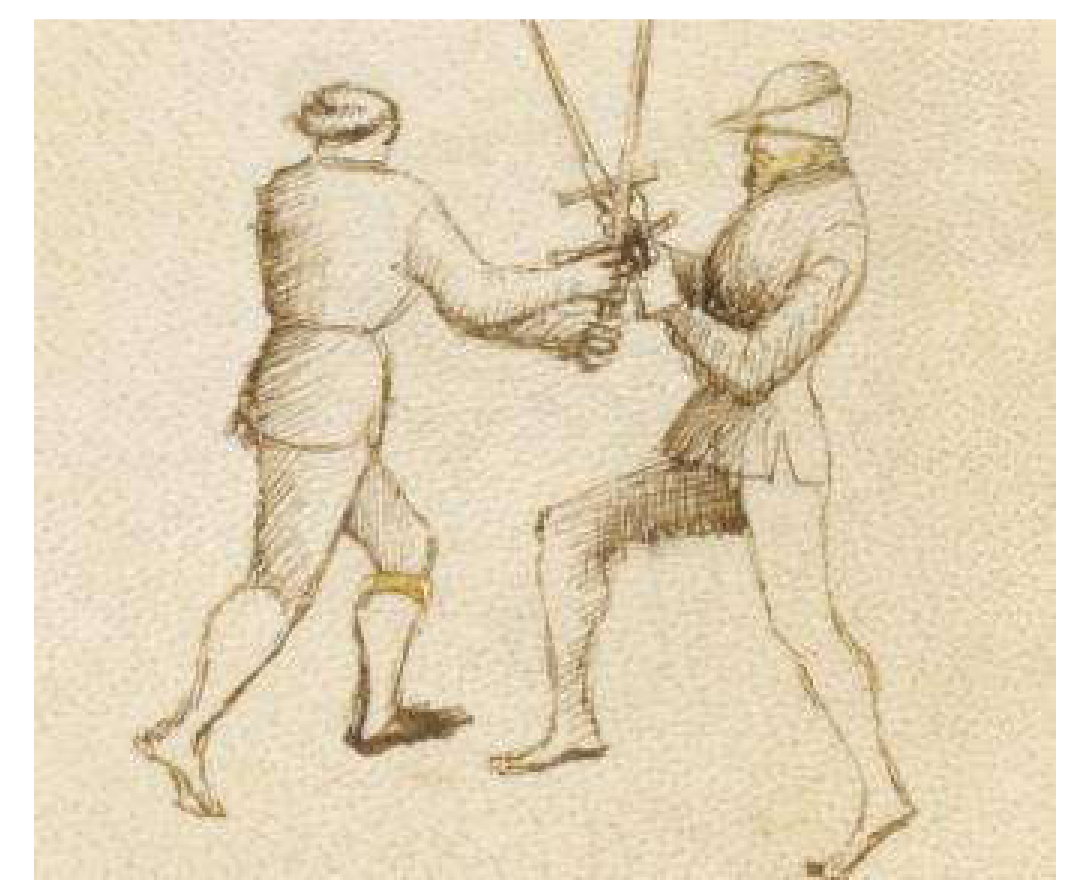
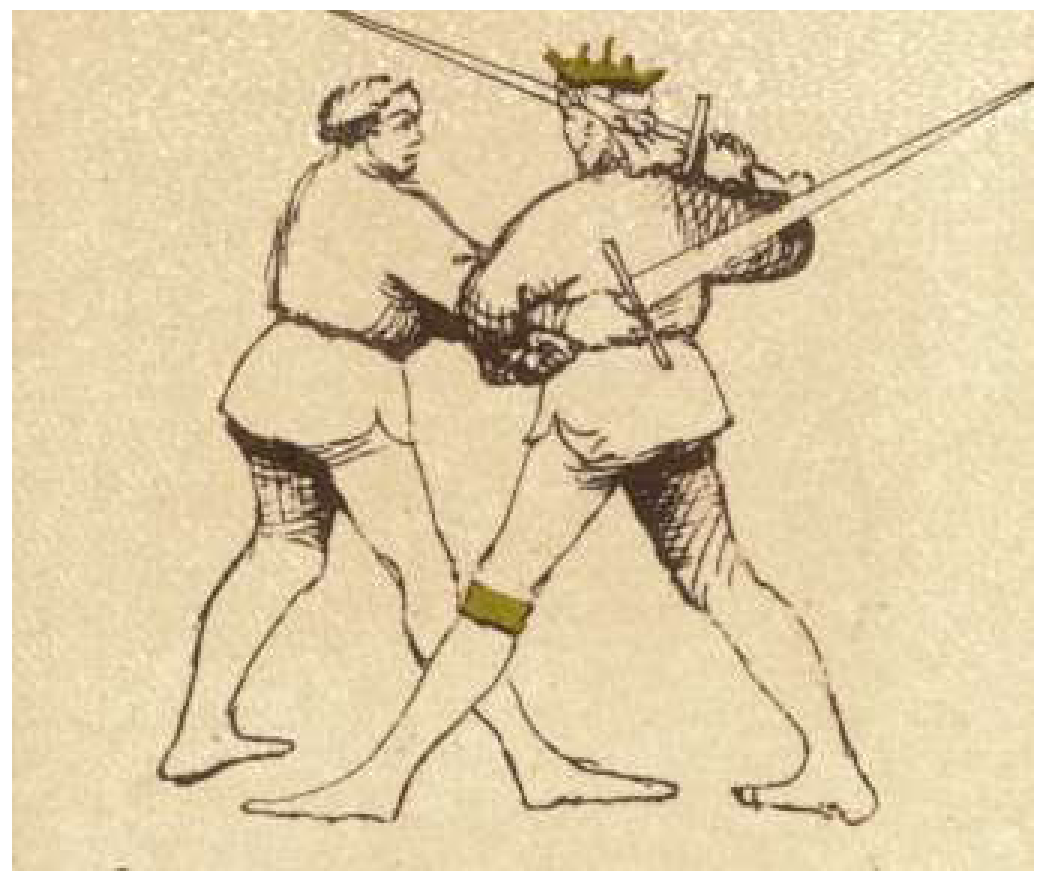
[29r-a] ¶ The student who is before me has completed the play which I said to do. Your arms have been bound in a middle bind. Your sword is prisoner, and it cannot help you. And with mine I can cause you a lot of injuries. Without doubt I can put my sword to your neck. I can immediately do the play which is after me.
[29r-b] ¶ This play follows on from the previous one, where the student struck his opponent multiple times while using his left arm to keep the opponent’s arms and sword pinned. Now I throw my sword around my opponent’s neck as depicted. Then I throw him to the ground to complete the play.
I have locked your hand with my sword, And I will give you a bargain with many strikes to your head; And I make the counter to the middle taking of the sword: This bind I have made which arises thus.
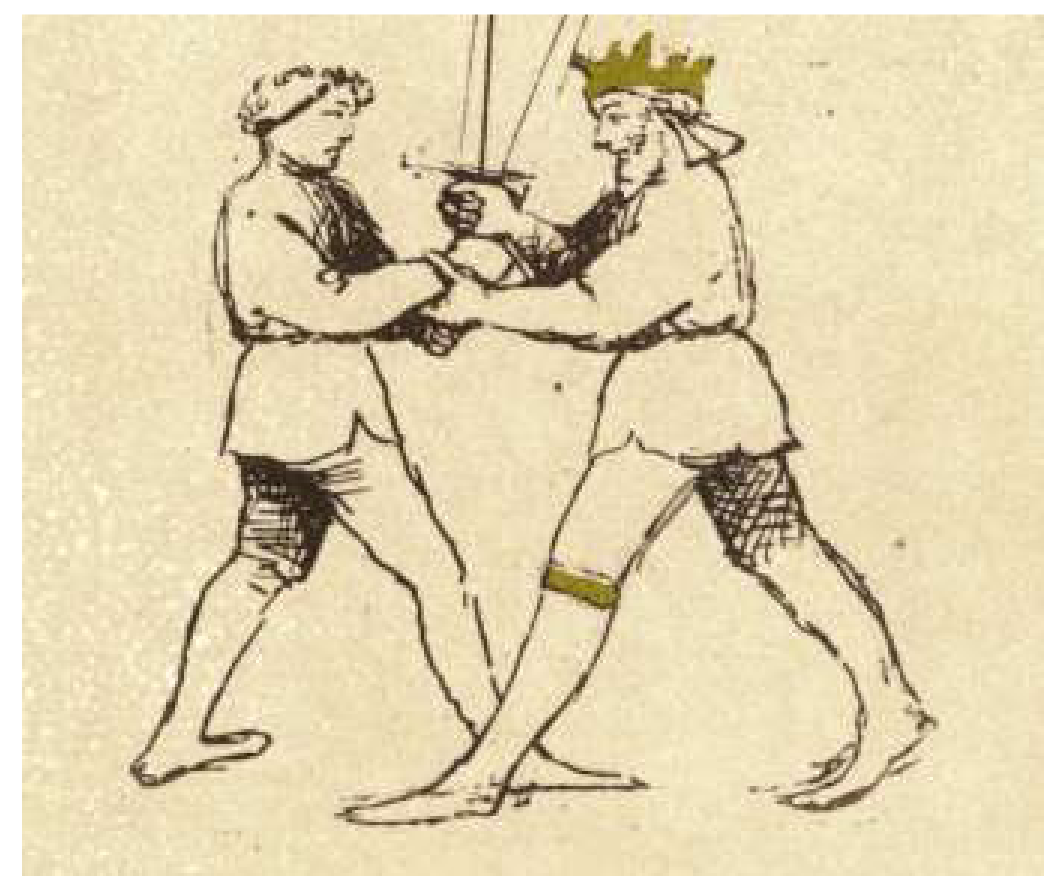
When I am crossed, I pass with a cover, and I injure you in your arms in this part. And this thrust you get in the face. And if I advance the left foot, both your arms will be bound. Or, that in the other play after me of grabbing you, you are bound at the sword by the hilt’s retention.
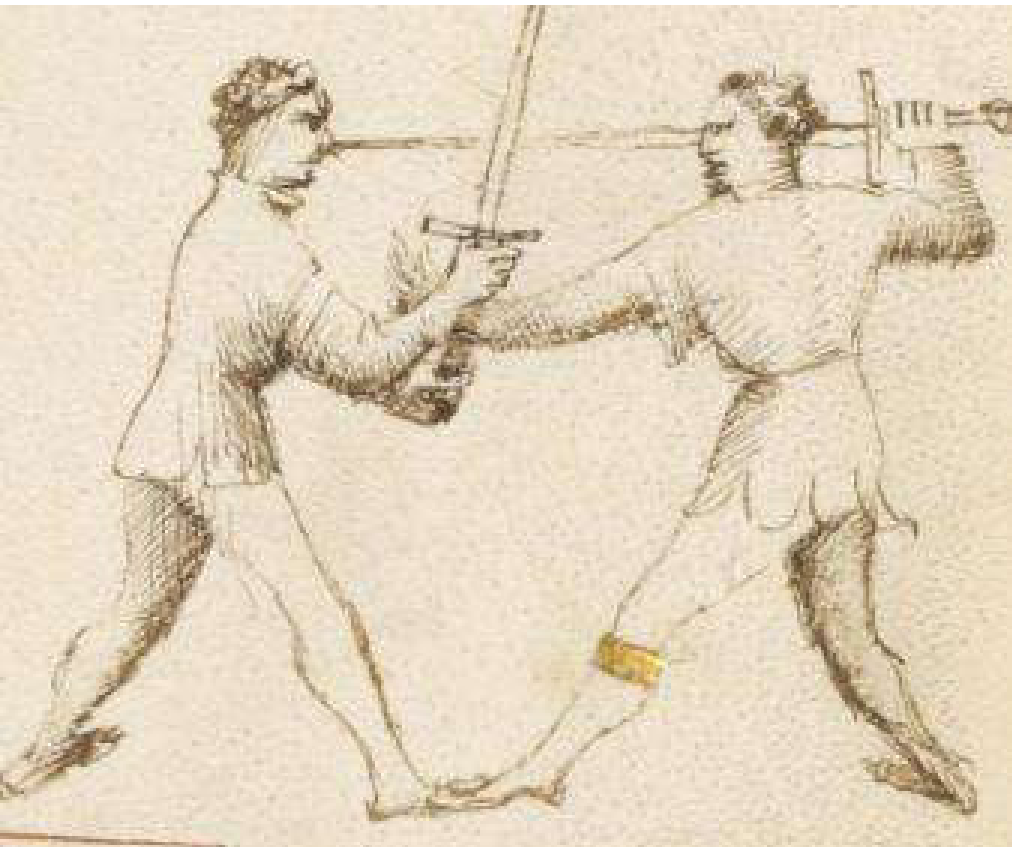
This is the grip that the student before me said to do to you. I can injure you without danger. I retain your sword’s hilt; I will give you cuts and thrusts cheaply (with no risk?). And this play breaks all sword-disarms, and doing it immediately spoils the narrow play.
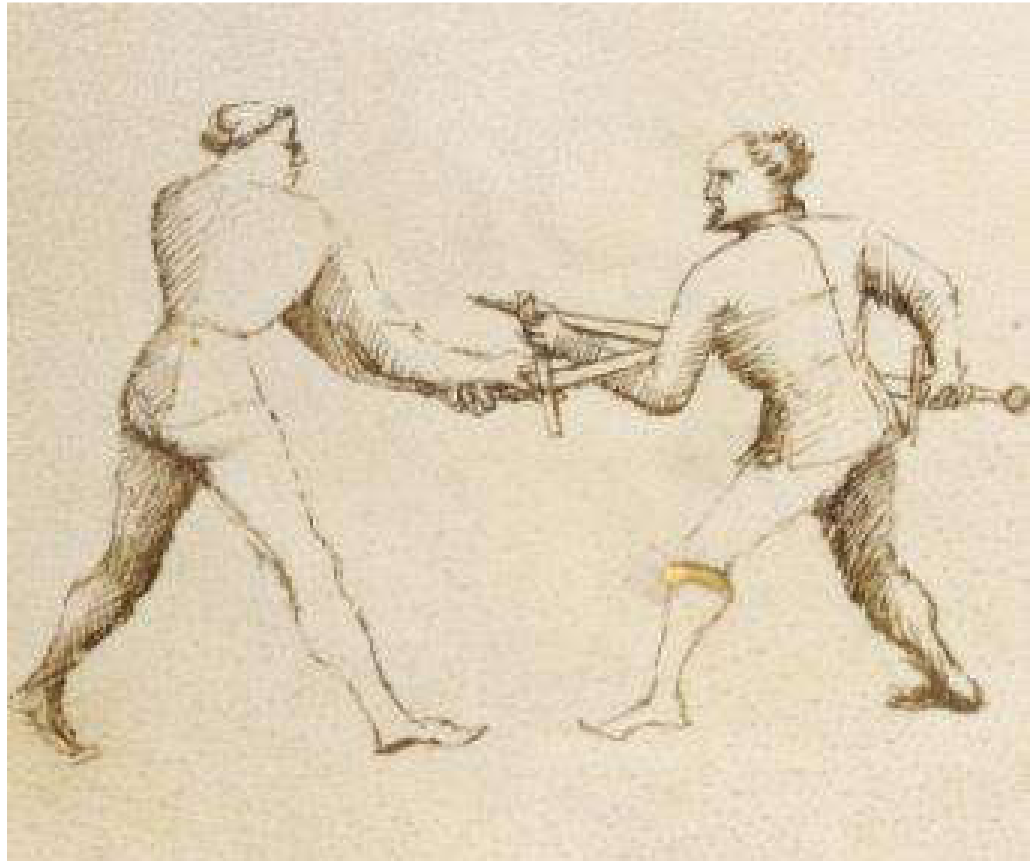
This play is taken from the first play of the First Dagger Remedy Master, who places his left hand over the opponent’s wrist to take the dagger from his hand. In similar fashion the student here places his left hand over the opponent’s right forearm, rotating it outwards to remove the sword from his right hand...
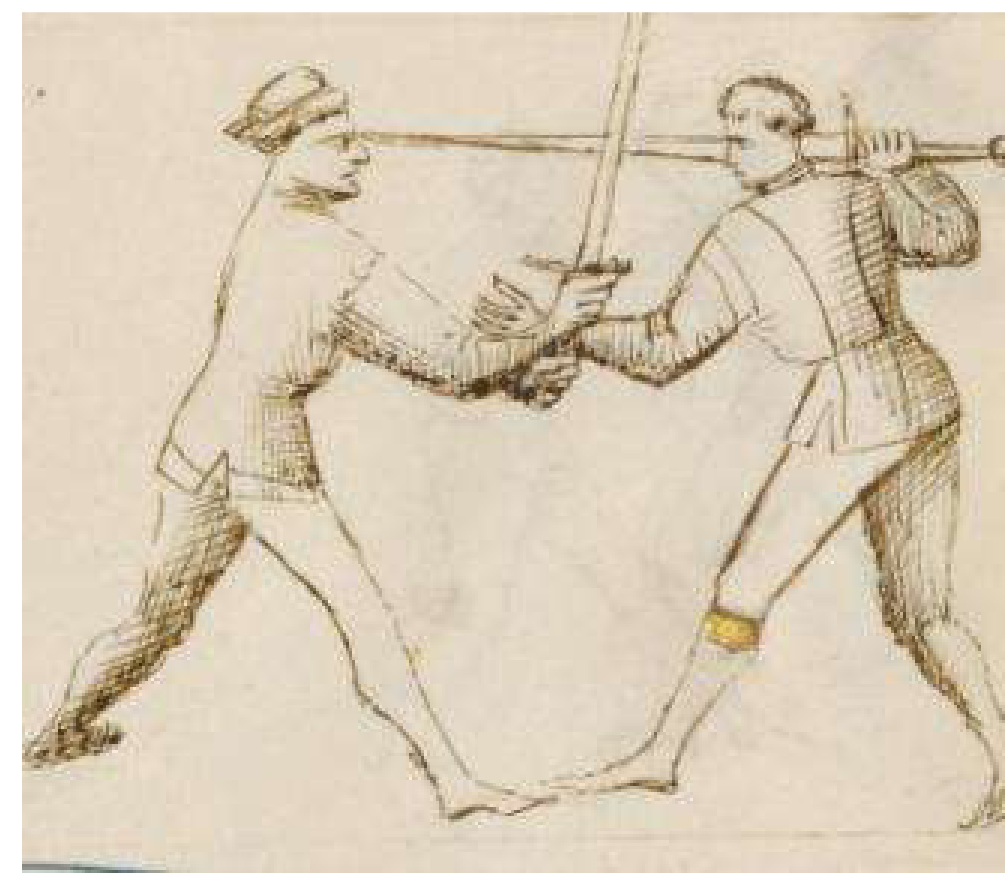
...Or from here he can transition to a middle bind, as shown in the second play of the above-mentioned First Dagger Remedy Master. And that bind belongs to this student.
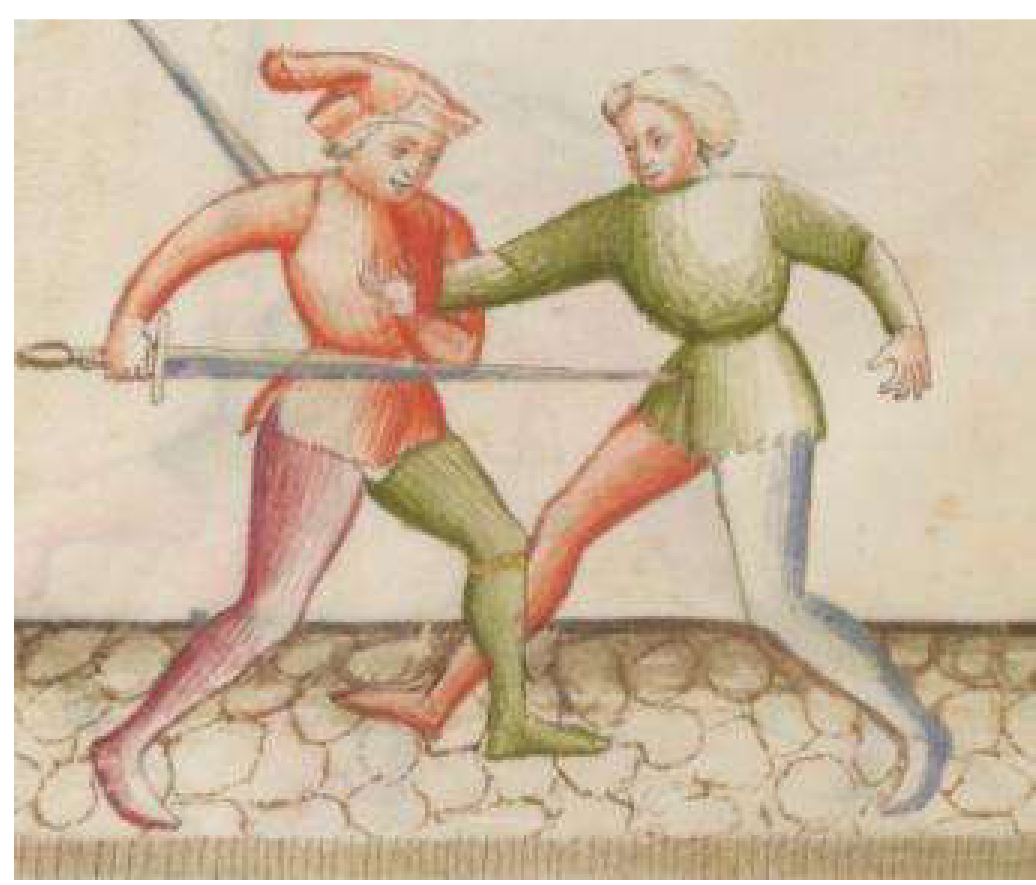
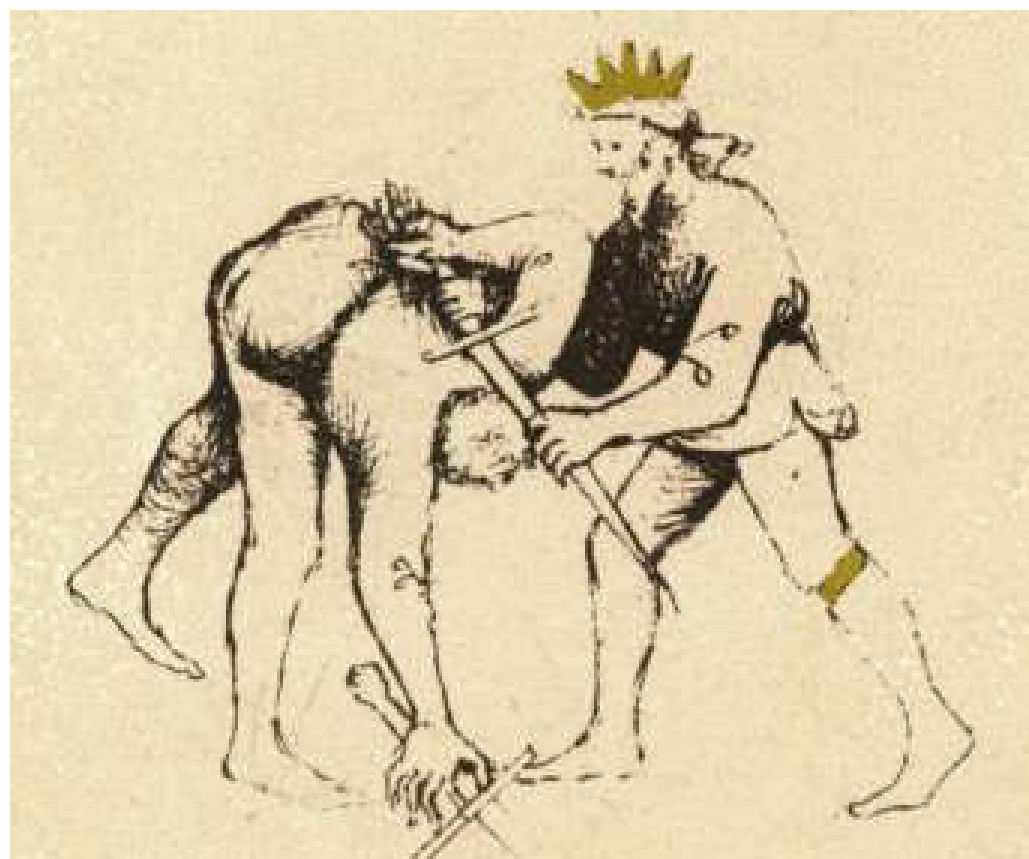
I am the counter to the student who preceded me, if he tries to use the second play of the First Dagger Remedy Master against me that you heard about previously, and this is how I am done. And when I do this play I doubt you will be able to remain on your feet holding your sword.
¶ I am also a counter to the student who tried to use the second play of the First Dagger Remedy Master against me. From the previous picture, if I now start to cut into his throat, he will stand up a little, and then if I move quickly, I can throw him backwards to the ground
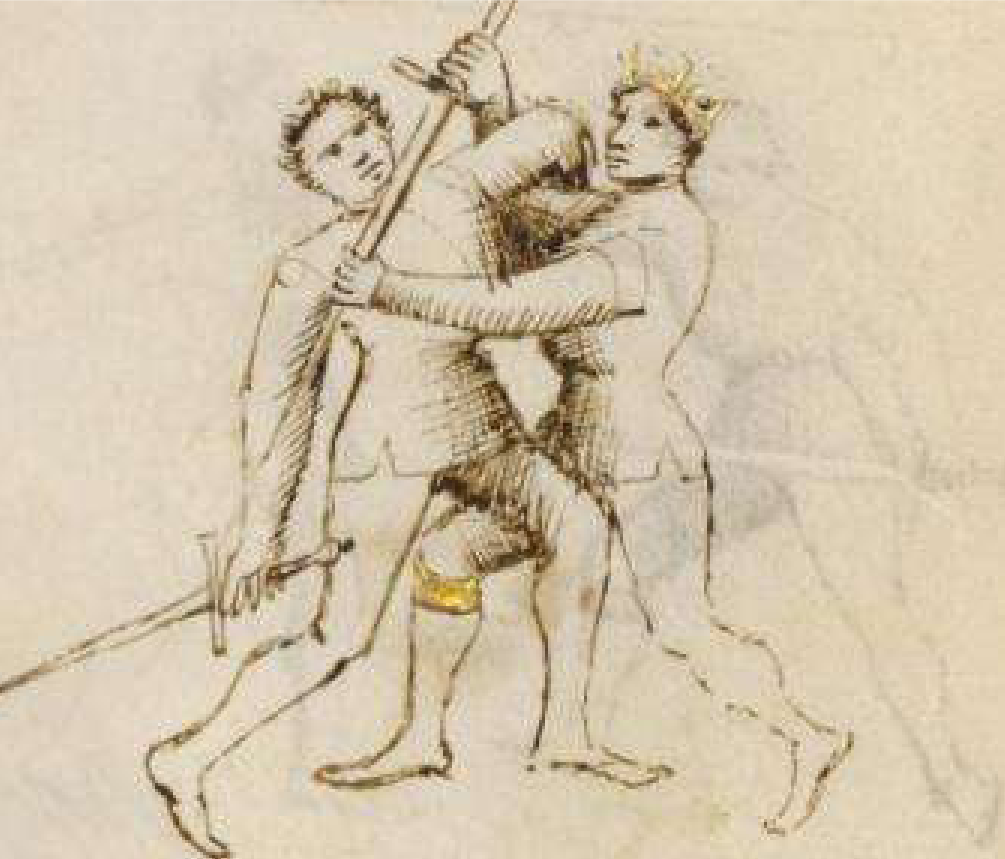
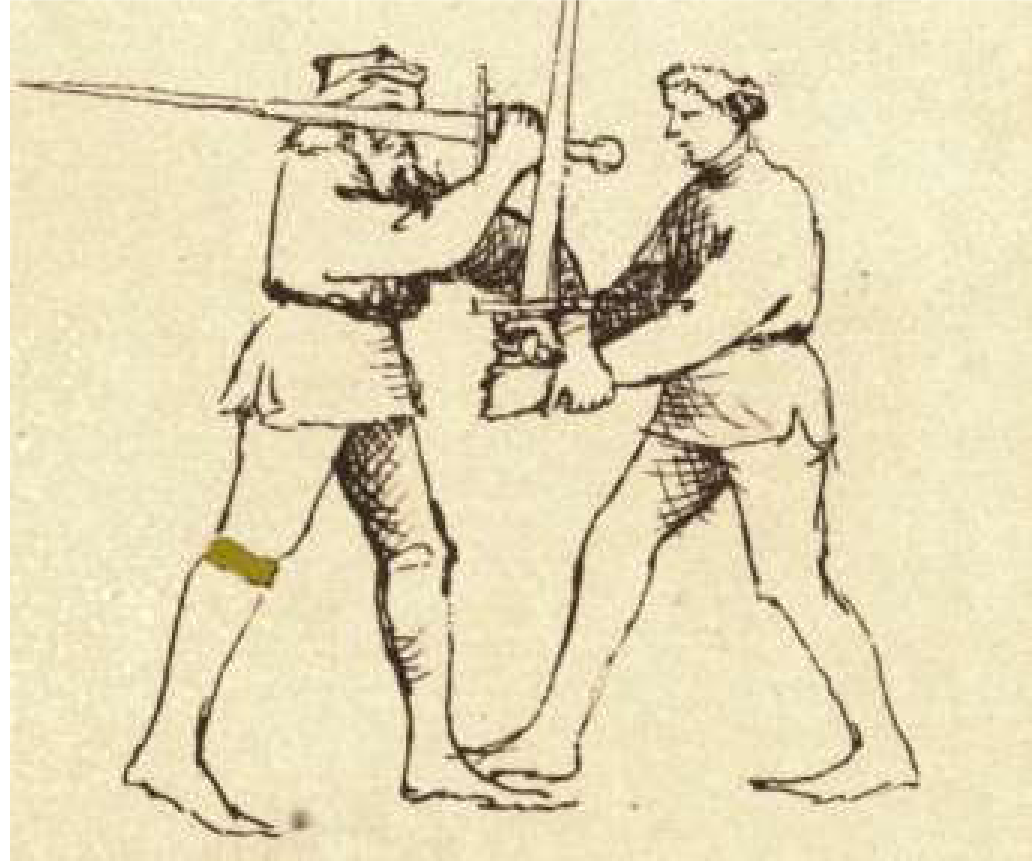
¶ This is a high sword disarm. With my left hand I pin his hands, while at the same time I press forwards against his his hands, while at the same time I press forwards against his blade with the grip of my sword so that he loses his grip on blade with the grip of my sword so that he loses his grip on his sword. Then I will deal him several good strikes. The his sword. Then I will deal him several good strikes. The student who comes after me will show how this play student who comes after me will show how this play finishes with the opponent’s sword lying on the with the opponent’s sword lying on the ground.
Following the disarm performed by the student who came before me, you will feel your sword fall to the ground. came before me, you will feel your sword fall to the ground. And now there is no question as to whether I can strike And now there is no question as to whether I can strike you
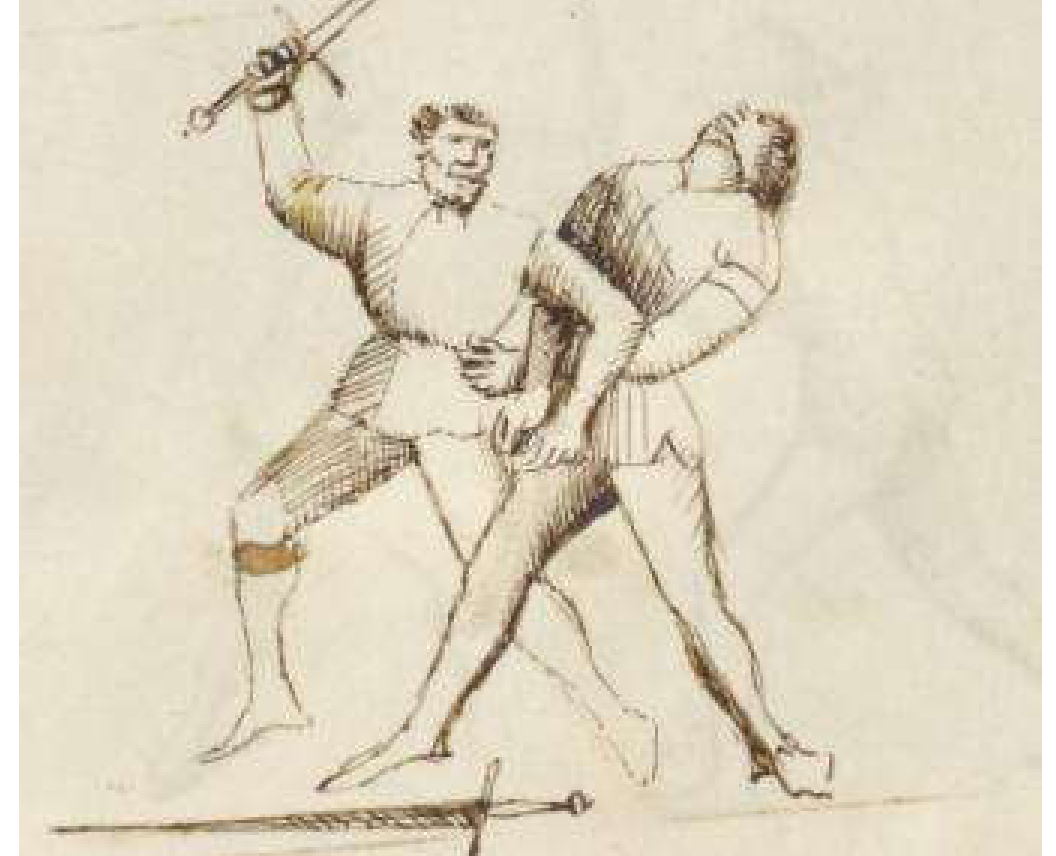
[15v-b] This is the taking of the sword from the middle: whoever knows how to make such turnings of the sword makes this one just as the first is made, save only that the catch is not the same. The first taking of the sword binds both of the arms, but I do not want to have such trouble so I separate one arm and hand from the other. He is not so strong that he could hold [his sword] and keep it from falling. As was said above, I am the taking of the sword from the middle, which was made a thousand times by Fiore of Friuli.
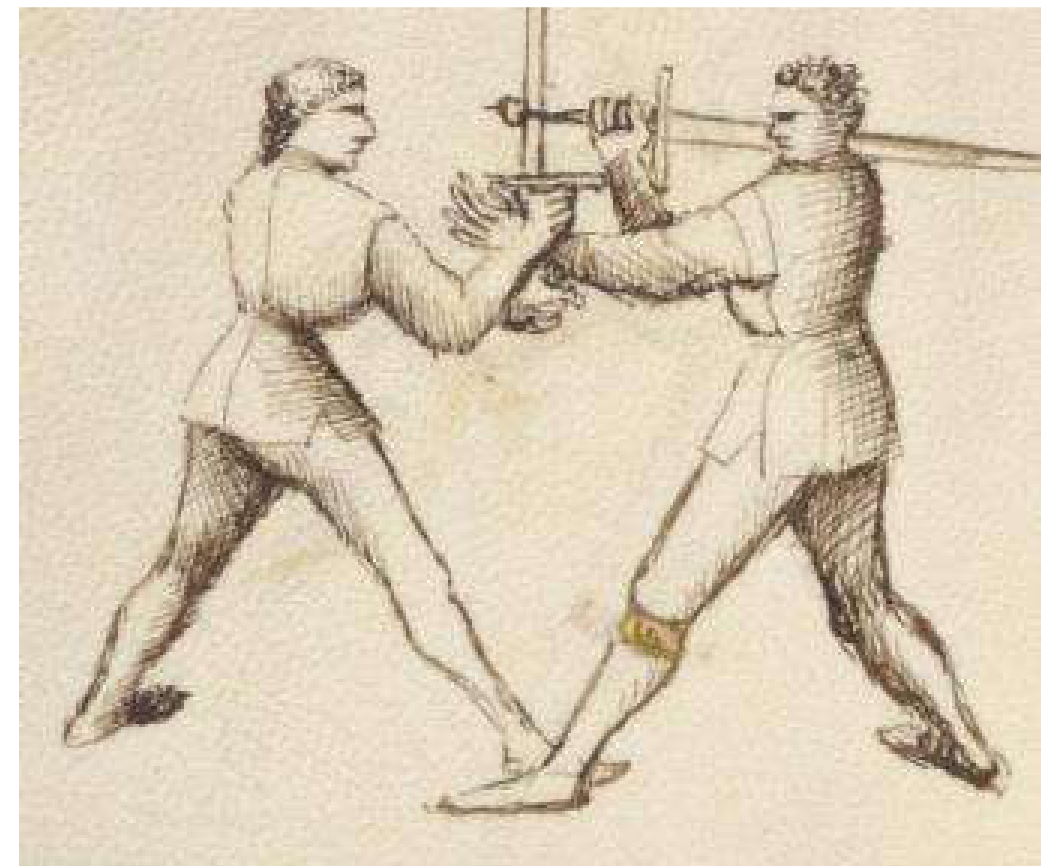
[30v-b] ¶ This is another sword disarm, named the low disarm. The low disarm is performed in a similar way to the high disarm, with the same rotation of the opponent’s sword, following the same path. With your right hand you press his blade forwards, making his sword handle rotate upwards, and you must keep your left hand on his handle as it turns
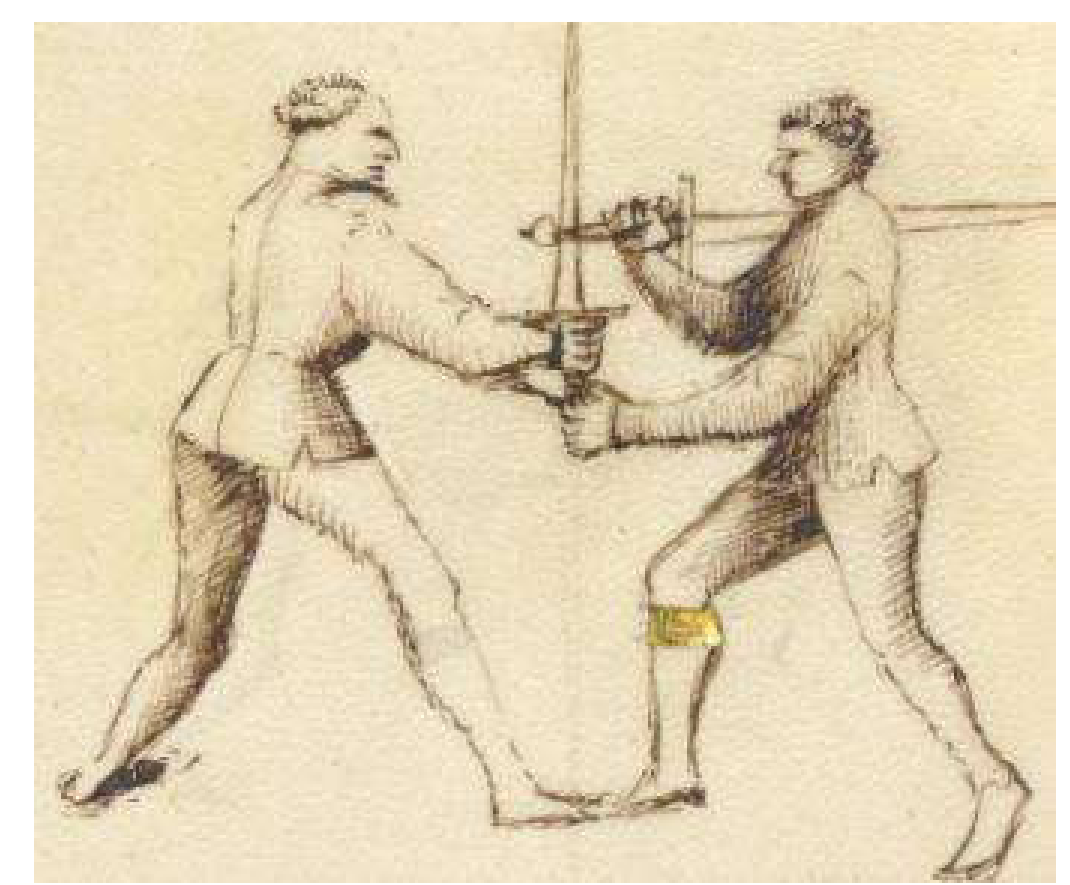
[15v-d] This is another taking of the sword, and it is done in this way: that when one is crossed in the narrow, the Scholar should thrust his right hand under his [sword] and grasp that of the player at the middle or above, immediately releasing his own sword to hit the ground, and with his left hand he should grasp under the pommel of the player’s sword and give it a full rotation to the right, and then suddenly the player will have his sword lost and the Scholar, righting [the stolen] sword with a half turn, can strike the player